
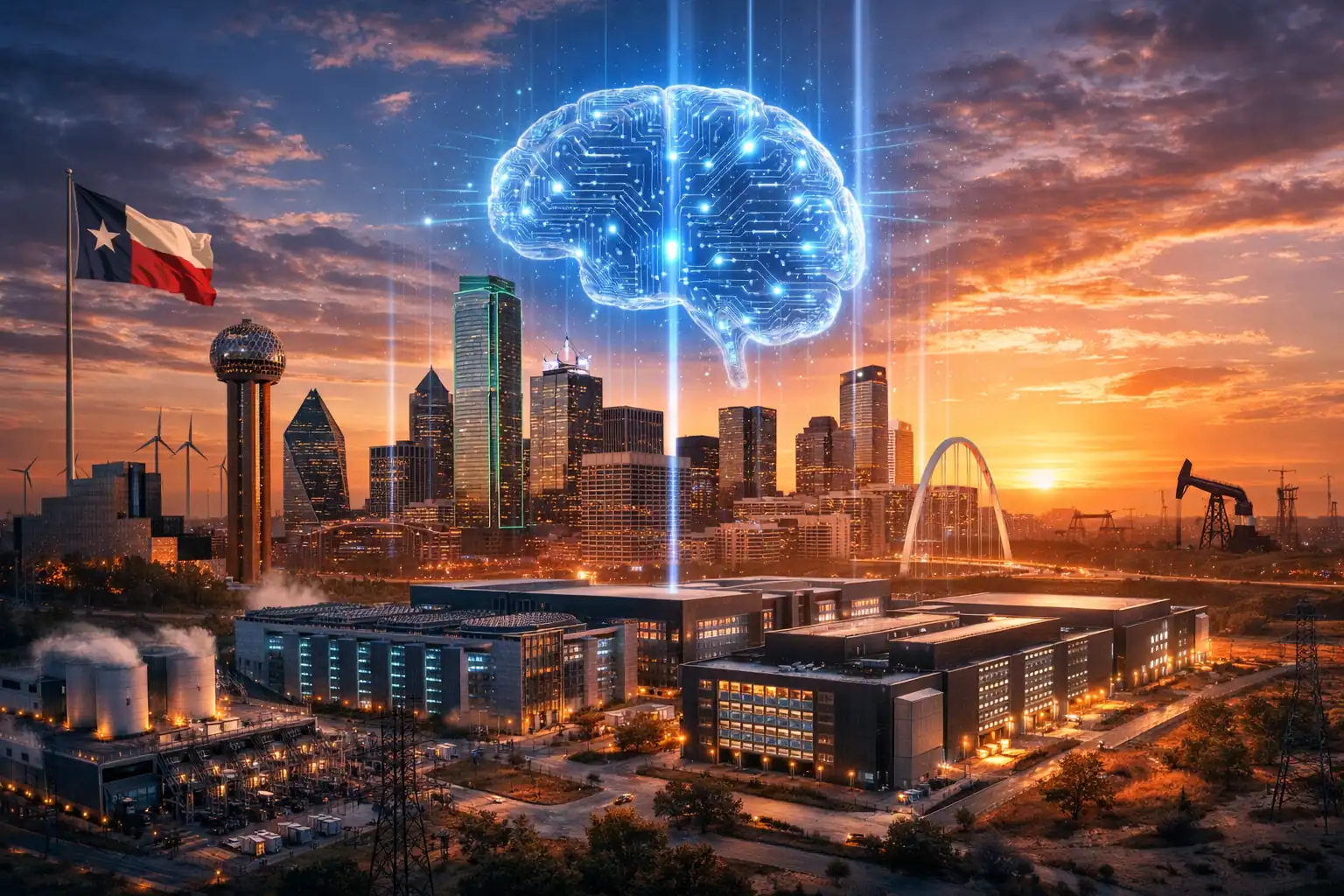
The Nuclear Bet: Texas Wagers on Unproven Reactors
📘 Introduction
Texas has a power problem it can't build its way out of fast enough, and the state's answer — increasingly — is nuclear reactors that have never actually been built. In under three years, Texas has gone from a governor's directive to study "advanced nuclear" to becoming one of the busiest small modular reactor (SMR) testing grounds in the country, with at least six distinct projects now in some stage of development, nearly all of them explicitly pitched around one customer: AI data centers.
The pitch is simple. Data centers need power 24 hours a day, seven days a week, and they need it without the intermittency of wind and solar or the emissions baggage of natural gas. Nuclear offers both. What the pitch leaves out is that no small modular reactor has ever reached commercial operation in the United States — and the one company that got furthest, NuScale, cancelled its flagship project in 2023 after costs spiraled and utilities walked away.
⚛️ Why Small Reactors, Why Now
The Bureau of Business Research at the University of Texas at Austin projects that average demand on the ERCOT grid could nearly triple by 2050, driven by data centers, electric vehicles, and electrification in the Permian Basin oil fields. ERCOT is currently sitting on a grid-connection queue of roughly 474 gigawatts — more than five times the state's current peak demand — and data centers account for the overwhelming majority of it.
That surge turned a slow-moving policy conversation into fast-moving law. Governor Abbott's August 2023 directive creating the Texas Advanced Nuclear Reactor Working Group led, by June 2025, to House Bill 14 and a $350 million Texas Nuclear Development Fund — the largest state-level nuclear commitment in the country. A year earlier, the federal ADVANCE Act had already told the Nuclear Regulatory Commission to speed up its reviews and cut licensing fees for advanced reactor developers by more than half. Texas didn't just get lucky with nuclear interest; it built the on-ramp.
🏗️ Six Projects, Six Bets
Last Energy — Haskell County, near Abilene. Thirty "micro" 20-megawatt reactors on a 200-acre site, adding 600 MW total. Unaffiliated with the nearby Stargate data center complex, but company executives point to Stargate's arrival as proof of the demand they're chasing. First reactor targeted for the end of 2029; the company has already filed to connect to the ERCOT grid.
Natura Resources — Abilene Christian University. A molten-salt, liquid-fuel research reactor — the first of its kind built in the US in roughly 40 years. A 1-megawatt demonstration unit is aiming for operation by late 2026 or early 2027, meant to prove out a commercial 100-megawatt design. Natura also pitches the waste heat for desalinating the Permian Basin's contaminated "produced water," a second revenue stream layered on top of the electricity.
Aalo Atomics — Austin. Sodium-cooled, truck-transportable 10-megawatt units, designed for mass factory production. Aalo recently partnered with AI cloud company Crusoe specifically to demonstrate a nuclear-powered AI data center by 2027.
Blue Energy + Crusoe — Port of Victoria. A 1,600-acre, up to 1.5-gigawatt AI data center campus running on a "gas-to-nuclear" strategy: natural gas power starting in 2028, transitioning to modular light-water reactors by 2031.
X-energy + Dow — Seadrift. Four 80-megawatt high-temperature gas reactors at Dow's Seadrift chemical plant, backed by $1.2 billion in Department of Energy funding, expected online in the early 2030s with excess power sent to the grid.
Fermi America — Project Matador, near Amarillo. The outlier in scale: a 7,570-acre campus on a 99-year lease from Texas Tech, envisioned to eventually reach 17 gigawatts of private power. Nuclear is part of the long-term mix, but the campus is being powered mostly by natural gas, solar, and wind well before any reactor comes online — nuclear generation isn't projected until around 2032.
💰 The Untested Part
Here's what none of these announcements dwell on: no SMR has reached commercial operation anywhere in the United States. Three are operating worldwide — a floating reactor in the Russian Arctic and a high-temperature gas reactor in China, plus one under construction in Ontario. NuScale, the first company to win NRC design certification, cancelled its Idaho project in 2023 after costs rose and utility partners couldn't commit.
Cost is the recurring obstacle. A grid-modeling analysis behind the UT study found that nuclear only becomes competitive in the ERCOT market when upfront capital costs fall to $3 million per megawatt or below. Current industry estimates from the National Renewable Energy Laboratory put actual SMR costs between $2.9 million and $10.1 million per megawatt — meaning several of these projects may not pencil out economically without heavy cost reductions Texas hasn't figured out how to deliver yet. Licensing adds more time on top of that: even at its fastest, NRC review takes 18 months or more, and newer reactor designs need operating data from demonstration units before regulators will approve commercial licenses.
☢️ The Waste Question Nobody's Answering
Every one of these reactors, however small, produces nuclear waste — and the United States still has no permanent disposal solution for it. Used fuel can remain radioactive for thousands of years. That's not a footnote; it's the same governor now championing a "nuclear renaissance" who, in 2020, joined environmentalists and oil companies to oppose a federal license for a company seeking to store spent nuclear fuel in West Texas. Texas wants the reactors. It has already said no to storing what comes out of them.
🧭 What Texans Should Be Watching
This is the same playbook Texans have seen with data centers themselves: big announcements, fast-tracked incentives, and very little scrutiny of whether the underlying economics or the disclosure requirements can keep up. If SMR costs don't come down as promised, who absorbs the difference — ratepayers locked into decades-long power purchase agreements? If a project stalls the way NuScale's did, what happens to the county that already rezoned land and extended tax abatements for it? And will Texas require the same transparency on reactor siting, cooling water use, and waste handling that it has spent the past year failing to enforce on data centers' own water disclosures?
None of that makes small nuclear reactors a bad bet. It makes them an unproven one, being made at scale, on a timeline set by AI companies rather than by the reactors' own track record.
🧾 Conclusion
Nuclear could give Texas the round-the-clock, low-emission power its AI boom says it needs. But "could" is doing a lot of work in that sentence. Six projects, zero US commercial precedents, and a cost gap regulators haven't closed is not a renaissance yet — it's a bet, made with public incentive dollars, on technology that has yet to prove it can be built on time and on budget anywhere in the country.
For more analysis on Texas energy and AI, visit PowerGrabTX.com.
AI data centers are reshaping Texas faster than most people realize. If you want to stay ahead of the changes affecting your community, energy costs, and local environment, join our update list.
Stay informed about AI's impact in Texas