What's actually happening — on the grid, the land, the water, and in your community.
Texas is in the middle of one of the largest infrastructure buildouts in its history — and most residents don't know it's happening. At least 248 AI data center projects are planned statewide. In just two years, 519 power-hungry connection requests have been filed with ERCOT. Tech giants are buying land, securing water rights, and locking in tax incentives at a speed that is outpacing every level of public oversight. This page tracks what's happening right now.
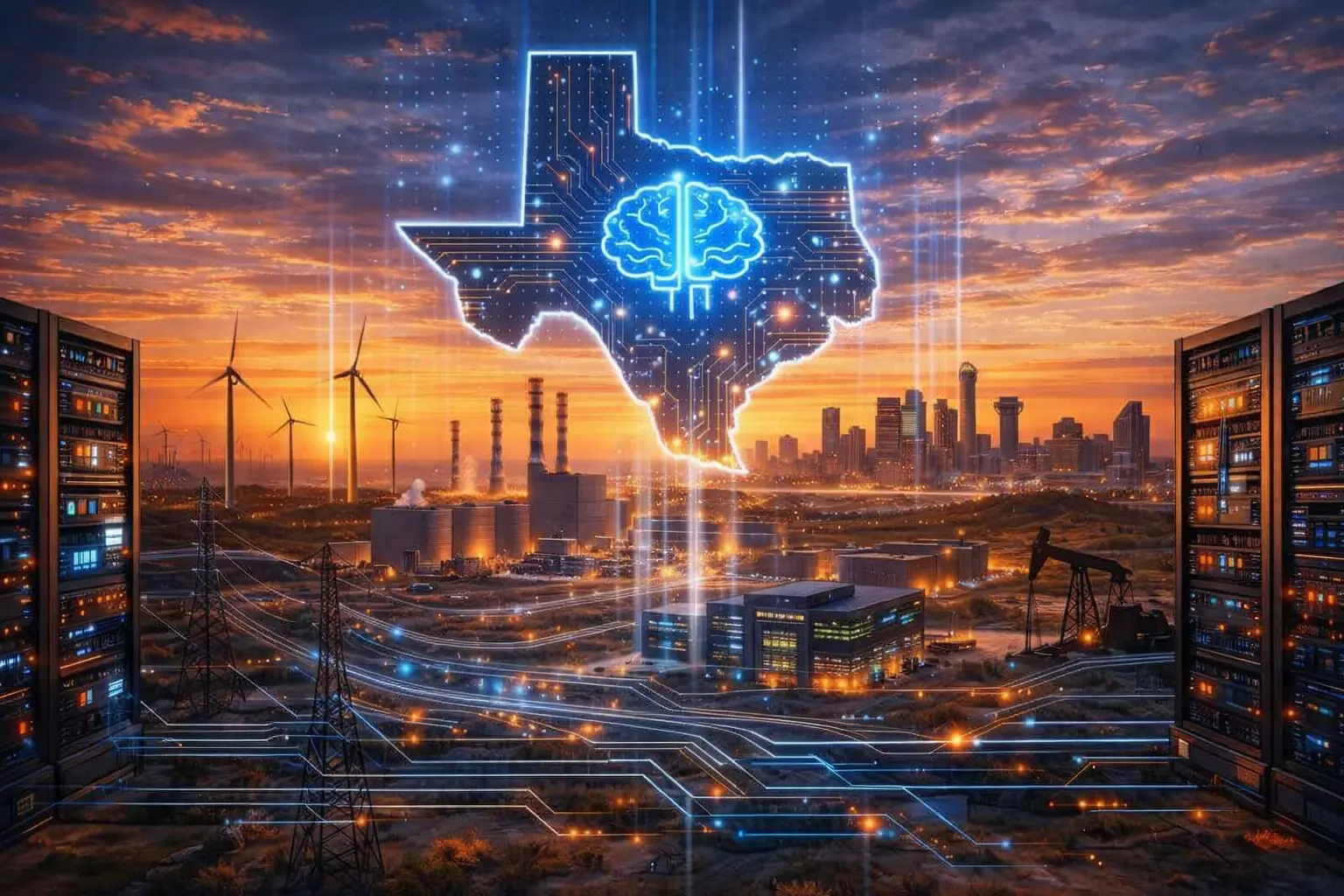
Texas didn't set out to become the national hub for AI infrastructure — it stumbled into it. The massive transmission corridors built two decades ago for West Texas wind energy turned out to be exactly what hyperscale data centers needed. Add cheap electricity, abundant land, a deregulated grid, and generous sales tax exemptions, and Texas became the most attractive destination in the country for companies racing to build AI capacity.
The players are household names. Microsoft is building one of the largest single capacity additions in its history — a new datacenter campus in Pecos, Texas. Meta has signed 1.6 gigawatt AI compute deals with Crusoe Energy across Texas. Nvidia is investing $2 billion in a Texas project in Sherman, testing its vision for AI-powered industry. Core Scientific is converting its Pecos site into a 1.5 gigawatt AI data center hub. Applied Digital has secured a $7.5 billion hyperscaler lease covering 300 megawatts. Hut 8 has launched a $9.8 billion, 1 gigawatt campus at Beacon Point. And that's before you count Stargate, Vantage, and dozens of others mapping gigawatt footprints across the state.
Each of these facilities demands enormous and continuous power — and Texas' grid is starting to show the strain. ERCOT reports that several large data center and crypto mining facilities failed voltage ride-through assessments ahead of peak summer demand. With Texas summers getting hotter and AI workloads climbing, the pressure on the grid is not a future problem. It's happening now.
The buildout is not concentrated in one corner of the state — it is spreading across Texas from the Panhandle to the Gulf Coast. North Texas has emerged as a major hub, with the Dallas-Fort Worth corridor attracting hyperscale investment and new power infrastructure. Pecos in West Texas is becoming a data center city, with both Microsoft and Core Scientific planting major facilities there. Sherman in North Texas is home to Nvidia's $2 billion AI industry project. South Texas rural communities are now fielding proposals that pit agricultural land and water supply against data center development. East Texas is seeing Big Tech arrive with promises — and locals pushing back hard.
What these facilities have in common is a near-total lack of public transparency. State officials sent surveys to data center companies asking how much water they use. Most aren't responding. There is little public visibility into facility size, cooling methods, environmental footprint, or long-term resource consumption. Companies are drawn to Texas by incentives and open space — but the true cost of this build-out is only beginning to surface.
The economic promises deserve scrutiny too. Companies cite job creation as justification for tax breaks and fast-tracked approvals. But a Dallas Fed survey found that most Texas companies using AI say it is decreasing their need for workers. University of Texas computer science admissions are down roughly 20% even as AI investment surges. The jobs narrative is not holding up.
The Texas power grid was not designed for this. ERCOT — the state's grid operator — is fielding 519 data center connection requests while simultaneously warning that AI-driven load forecasts may be overstating actual demand, creating a planning problem in both directions. Too much capacity approved and ratepayers foot the bill for unused infrastructure. Too little and the lights go out on a 110-degree August afternoon.
Water infrastructure faces a quieter but equally serious challenge. Data centers require vast quantities of water for cooling — millions of gallons per day for a large facility. State Representative Erin Zwiener confronted developers of a proposed data center in her district with a simple question: "What's in the water?" The developers couldn't answer satisfactorily. Texas officials want to know how much water these facilities consume. The companies, by and large, are not telling them.
Roads, transmission corridors, and local permitting systems are similarly strained. Projects that would normally take years of environmental review and community input are being fast-tracked. Cities are left scrambling to support growth they didn't initiate — and in many cases didn't fully approve. Governor Greg Abbott has now recommended sweeping data center regulation for the 2027 Legislature, including eliminating the sales tax exemption that has been one of the biggest draws for companies choosing Texas.
A USA Today poll published in June 2026 found that most Texans oppose data centers in their communities. That's a remarkable finding given how aggressively the state has courted this industry. The gap between what Texas politicians promised residents and what residents are actually experiencing is growing — and so is the pushback.
In Lewisville, city leaders didn't wait for a data center to arrive before acting — they passed proactive legislation banning data center construction entirely. In South Texas, local officials and economists are openly debating whether the water and farmland costs of data center development outweigh any economic benefit. In East Texas, community voices are describing Big Tech's arrival as resource extraction — coming to take what the land has and leave little behind.
The lived experience of communities near these facilities includes 24/7 construction noise, heavy equipment traffic, vanishing open land, and water systems under new pressure — all while tax incentives flow to the companies and locals are left asking who actually benefits. As more projects break ground, the political battles are escalating. This is no longer a niche environmental debate. It is a mainstream Texas issue.
"Big Tech is coming for East Texas, coming to pilfer its resources and siphon off value from it."
— East Texas News, April 2026